
Are We On the Same Page?
The book and our collective attention

Friends!
This week, we proudly published Attensity! A Manifesto of the Attention Liberation Movement. Over the course of two sold out, back-to-back launch parties in Manhattan and Brooklyn, the Friends of Attention and the SoRA team gathered several hundreds of friends (old and new) to think about the future of Attention Activism. It has been a joyous week.
2026 is a curious time to bring a book into the world. The rise of Large Language Models and the decline of literacy rates signal that the book’s status as the paragon of textual culture is a thing of the past. These days, it’s fair to ask: What exactly is a book for?
We are not defeatists, and we believe, sincerely, in the future of a reading public. That said, we are simply not going back to, say, 1949, when the first edition of Simone Beauvoir’s 978-page work of feminist phenomenology, The Second Sex, sold 22,000 copies in its first week. The world is turning.
Here’s one possibility: where once books were the occasion for a readerly solitude, now, in a time of increasing isolation, they are the occasion for togetherness. Books are objects of unusual attentional density. How many hours of thinking and talking and editing went into the 1.25 pounds of paper and cardboard that is Attensity!? It would be hard to calculate. But we suspect that the gravity exerted by such objects may countervail the human frackers’ insistent tug toward solitary time-on-device. We spend enough time alone these days — perhaps books are meant to bring us together:
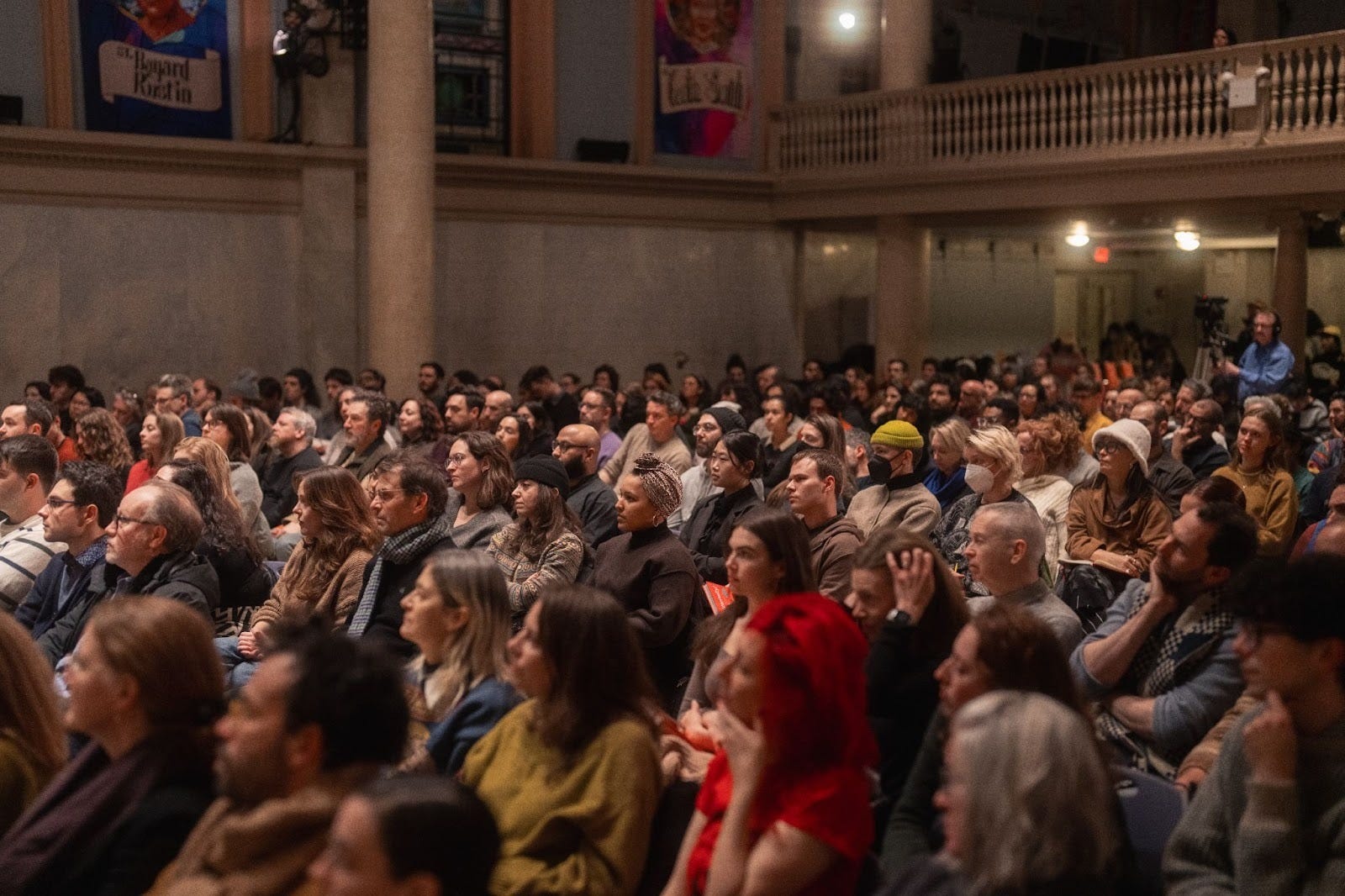
Doubtless the future of the book has many faces. But this week’s celebrations have us feeling pretty rosy about what’s to come. In the following newsletter, we think about the future of THE BOOK. Thank you for being with us — and here’s to the next chapter!
Bibliophilically yours,
Peter Schmidt
Editor-in-Chief
Visions of Attention
An archive of images and mini-essays on the myriad modes of attention
In Fine Print
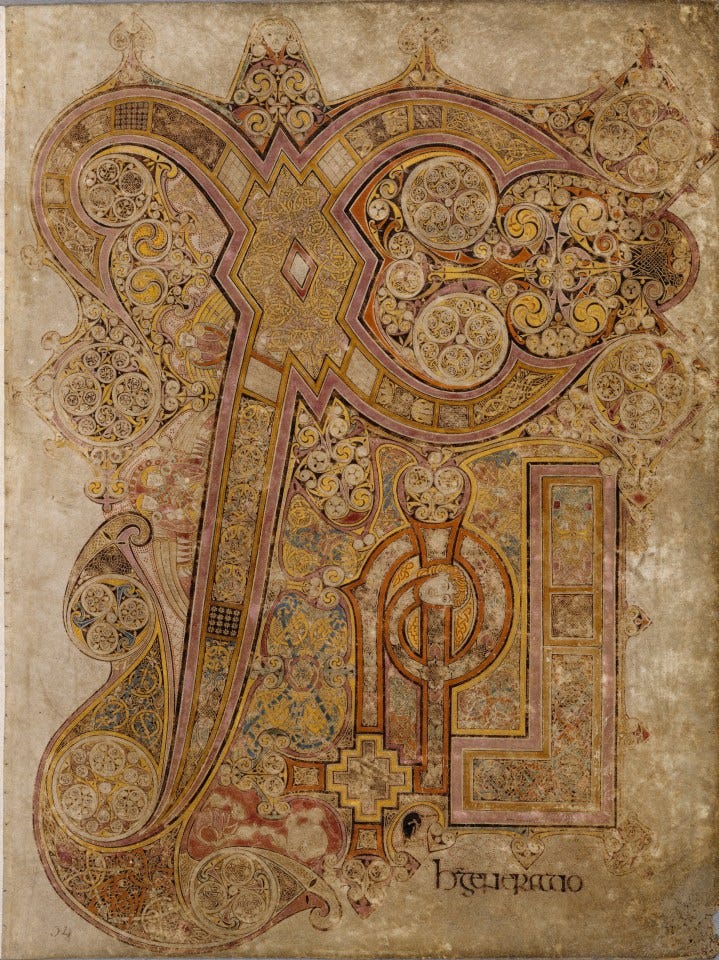
Crafted around 800 CE, likely between the Scottish island of Iona and the town of Kells in Ireland, The Books of Kells represents one of the finest examples of the “insular” style of medieval manuscript illumination. This Irish tradition preserved a symbolic vocabulary from pre-Christian Celtic culture, where the natural and supernatural intermingled freely. The pages teem with creatures both real and fantastical – cats, mice, otters, serpents, angels – amid woven patterns and geometric spirals, a visual synthesis of indigenous mythology with Byzantine and Coptic iconography.
The famous Chi Rho page, pictured, marks Matthew’s telling of the nativity narrative. Its painstakingly intricate images are surrounded by pages where words are misspelled, strewn about, and difficult to decipher. The Book of Kells was itself a sacred object designed for pious attention, probably displayed on the altar during Mass. Like stained glass, it made theology visible and accessible, transforming its content into something beheld rather than read. Even today, the pages on display at Trinity College Dublin are rotated every 12 weeks for conservation purposes, a historical echo of its ecclesiastical origins. Contexts change, but attention is eternal.
A Page Out of the Book
An excerpt from our book, ATTENSITY! A Manifesto of the Attention Liberation Movement, for our Substack community
“But we also put STUDY at the sweet center of Attention Activism because there are few institutions that have influenced the nature of human attention more powerfully and more continually than “school.”
What is a school, after all? A school, the obvious answer goes, is a place where people go to learn. What precisely is being learned, transmitted, acquired? Information, you might wager. But surely a school of dance is doing more than transmitting “information” to its students. A trade, then? But the students of Socrates were no more employable for having followed his winding inquiries.
Rather, we propose that people go to school to learn how to attend. Chemistry and math and history (and dance, and juggling, and pastry art, too) are all methods of dividing up the world and the ways we interact with it. What is always at issue, across all these subjects, is how to give attention, and to what. Learning attention is learning to be equal to the challenges and opportunities of our freedom—in relation to everything out there.
For the world is vast and complex. To navigate it, to make it inhabitable, to establish the continuities of shared life in and across time, generations before us have fashioned techniques for looking and listening and making and doing. Techniques, in other words, for attending.
These attentional forms are a precious inheritance. They create the conditions of possibility for our being together—and being with ourselves, too. Without them, the world cannot but be senseless and mystifying—to anyone, but to its newest inhabitants above all. Without the formation of attentional capacities, our tottering tykes and teenagers alike would be incapable of moving through the world—which would be, after all, fashioned according to rules and patterns of behavior utterly beyond their grasp! And there can be no meaningful human freedom in an incomprehensible chaos. As the political theorist Hannah Arendt reminds us, the cultivation of shared forms of awareness and recognition and reflective judgment is how a human world doomed by human mortality is both sustained and continually made anew.”
ATTENSITY! A Manifesto of the Attention Liberation Movement is now available for purchase. All proceeds support our non-profit and our programming efforts to build a movement of attention activism. Purchase a copy today!
Stuff for Study: Reading the Room
Readings and other resources for continued learning on attention and politics
Fanfiction, mystical texts, and reading with the full body — Anna Wilson for Aeon
We used to read things in this country — Noah McCormack for The Baffler
Reading ourselves to death — Kit Wilson for The New Atlantis
If you quit social media, will you read more books? — Jay Caspian Kang for The New Yorker
Goodbye to the graphosphere — Benjamin Kunkel for n+1
Reading notes: from apocalypse to dialectic — D. Graham Burnett for The Hinternet on Substack
— Czarina Ramos
IRL

Thu, January 29th: Celebrating the launch of Attensity, performance artist Park Karo will lead the first gathering of our VESSELS art program, a Ritual of Attention. RSVP HERE!
Tue, February 3rd: Join Kathleen Quaintance in our IRL three-week seminar WEAVING ATTENTIONS on the textile arts as a sanctuary of attention. Enroll HERE!
Find more workshops, events, and gatherings here!
Love this reframing. Thinking of books as gathering points rather than just solo experiences feels right for where we are culturaly. I've noticed that the densest reads actually work better when there's someone to process them with. The idea that schools teach us how to attend, not just what to know, is a distinction that clarifies alot about why educaton feels so misalinged right now.