
Becoming Accustomed
Attending to the practice of rituals

Friends!
My fiancée recently brought home the latest version of the iPhone. It is, in a word, spectacular: the candyland colors, the haptic quivers and throbs, the ineffable friendliness of the simplest visual elements. The thing is disarmingly fun to handle, and, in direct proportion, extremely unnerving.
Here’s what really freaked me out: We shortly discovered that the thing wouldn’t turn off. When we pressed the power button or set it on the table, face down, the screen didn’t go dark, it just went dim – as if a smoggy sky had drifted over the display. There it sat, scumbled and subdued, but most definitively on. After some research, we learned how to disable this “Always On Display” setting, and did our best to ignore the ominous double valence of the phrase.
The occasion for this new gadget was, of course, the holidays – our annual ritual that honors, at its pre-Industrial root, the inevitability of night. It’s no coincidence that our ancestors from the northern hemisphere chose the gloomiest season to gather, worship, and give thanks; we sing because of the darkness, not in spite of it.
But in the world lit by the screen’s perpetual glow, there is no need for ritual. As Jonathan Crary has argued, the 24/7 activity of tech-mediated capitalism sees every moment in time as equal, and equally fungible – time, in a word, as money. This logic, and the world it has built, is incommensurable with the ritual notion of time as the home of the sacred.
Yet our contemporary holidays contain both: consumption and holiness, retail and ritual, a tangle of the deep past and a rapidly collapsing future.
It’s clear we can’t go back. It’s also clear we can’t go forward, if forward means being Always On Display. Where else to go, then, but round and round? Ritual is how we resist the false binary of reactionism and accelerationism. It is our mode of return — an eddy in the frothy flow of time in which we might, should the waters still for just a moment, catch a glimpse of ourselves.
Yours,
And yours again,
Peter Schmidt
Editor-in-Chief
Visions of Attention
An archive of images and mini-essays on the myriad modes of attention
The Shape of Absence
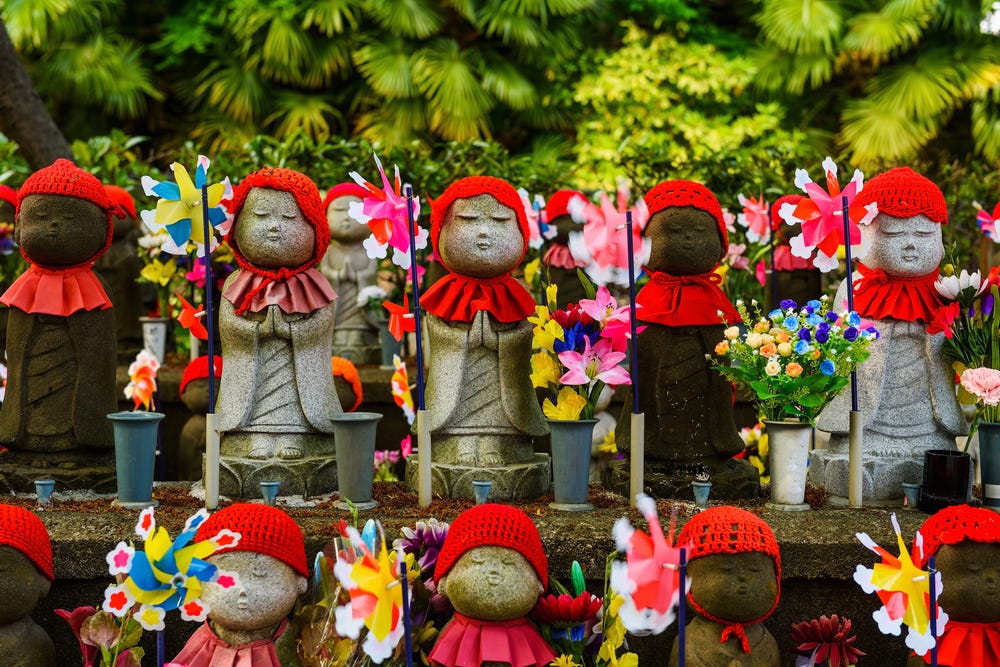
Standing beside the Tokyo Tower, one of Tokyo’s great odes to modernity, is the Zojo-ji Temple, a Jōdo-shū Buddhist temple in the city’s Minato ward. To the right of its nearly 700-year-old main hall are rows upon rows of small statues lining the temple grounds. They are thoughtfully adorned and carefully dressed, often in red, a color known to ward off evil. These figures are Jizō, bodhisattvas who have chosen to remain on earth as guides and protectors of children, particularly the Mizuko: the “water children” who were never born. Miscarried, aborted, stillborn, or otherwise lost before arriving to the world in living form, Mizuko exist in a perpetual liminal space. The statues of Zojo-ji Temple serve as embodied offerings to these waylaid souls.
How do we give form to absence? Ritual has long offered humans (and nonhumans!) a container to hold grief — to give space, shape and sustained attention to the formless energies that swirl within and between us. The Mizuko Kuyō ritual invites mourners to channel loss and heartache into being through acts of care and devotion. In a world where grief is often stowed away, the Mizuko Jizō serve as public witnesses to sorrow. They remind us that while grief can isolate, it can also connect.
The First Noble Truth of Buddhism teaches that suffering is not an aberration, but an essential condition of life itself. Carefully carrying the Mizuko across worlds in their cloaks and robes, the Mizuko Jizō guide mourners through an embodied encounter with dukkha (the noble truth of suffering). In tending to these statues, mourners ritualize their grief and enter into a shared field where parent and child’s suffering are held together. Through honoring what cannot be held, the bereaved enact a profound paradox: bringing sorrow into being, making visible that which — and those who — were never fully here.
Stuff for Study: In Ceremony
Readings and other resources for continued learning on attention and politics
Spider divination as a tradition of truth-seeking — David Zeitlyn for Aeon
Can art as ritual stabilize our warping time? — Nathan Gardels and Byung-Chul Han for Noema
The Earth dreams in ritual — Christina Nichol for n+1
Taking stock of our technological liturgies — L. M. Sacasas for The Convivial Society on Substack
Searching for ritual in a season of mystery — Erika Howsare for Longreads
— Czarina Ramos
IRL
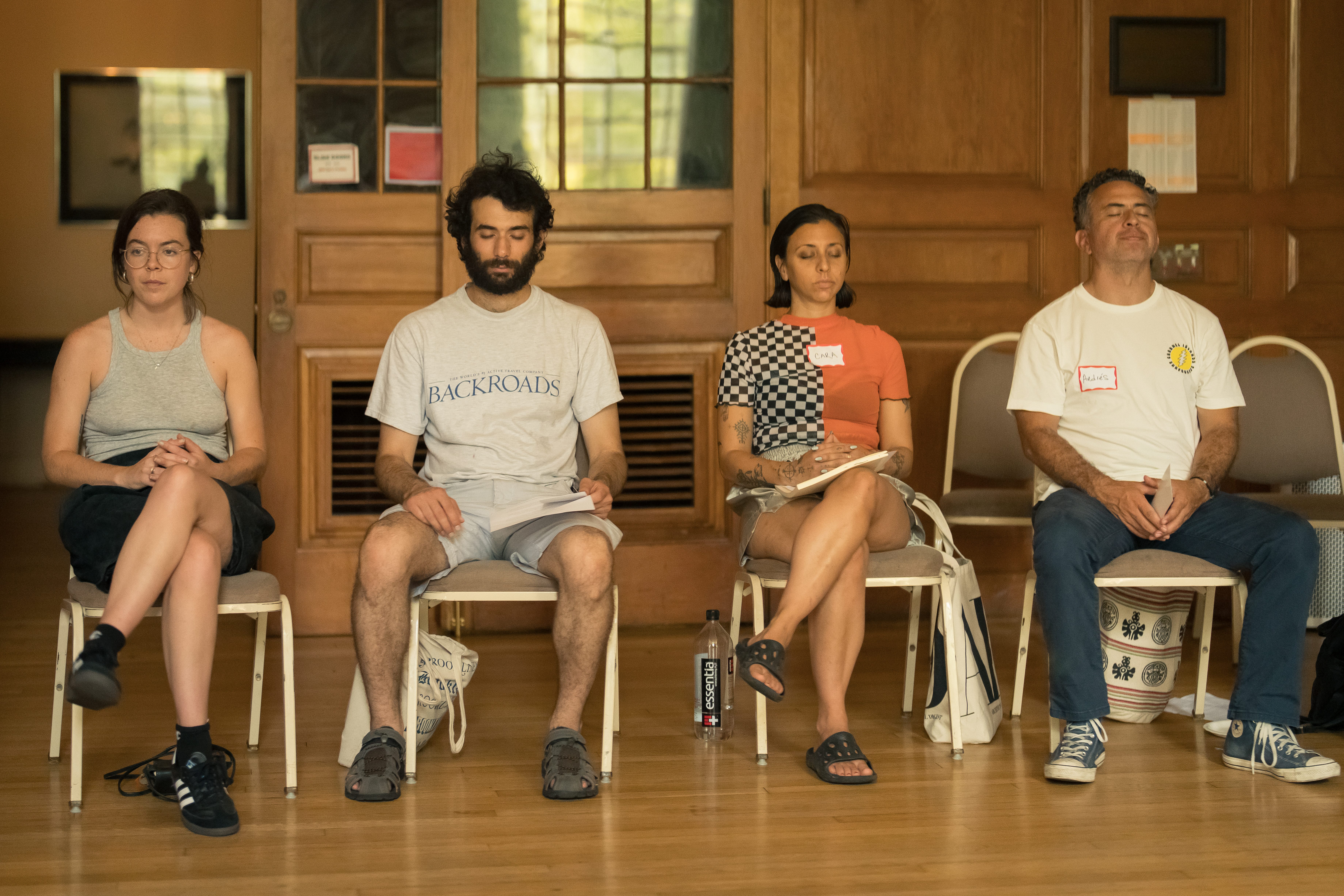
Tues, Jan 20th at Judson Memorial Church: Join D. Graham Burnett, Alyssa Loh, and Peter Schmidt of the Friends of Attention for the launch of their new book, ATTENSITY! A Manifesto of the Attention Liberation Movement. RSVP HERE!
Find more workshops, events, and gatherings here!