
Feasting for the Senses
On attention and eating

Friends!
I’d wager that if you got a group of five random twenty-something New Yorkers recounting their 2020 COVID lockdown experience, you’d probably hear the word sourdough mentioned at least once. Confined to the limits of our living spaces, many of us found solace in the metabolic life of yeast and bacteria, watching our sourdough starters rise and fall across the hours before beginning the days-long process of baking a loaf.
Admittedly, my interest in sourdough fizzled once the city opened back up. My social calendar didn’t have much room for sitting by the oven; feeding the starter became more inconvenience than ritual. As post-pandemic life quickened its pace, the days-long act of breadmaking began to seem simply out of scale.
My abandoned kitchen tools are now mostly a reminder that a relationship to food is, in some ways, a relationship to time. Our return to the timescale of business as usual is evident in the explosion of venture-backed fast casual bowls, streamlined to perfection in their preparation (by both human and robot) and agreeable enough to be shoveled quickly and mindlessly into our mouths while we populate spreadsheets. I hate to ring the alarm, but even the famously pro full service French are opting for lunch to go these days.
In his book How to Eat, the Buddhist monk Thich Nhat Hanh writes, “The way we drink our tea can transform our lives if we truly devote our attention to it.” Food is, after all, an opportunity for ritual built into the cycles of our physical bodies. Yet daily hours optimized for convenience and productivity can turn mealtimes into afterthoughts. How can food nourish us when we turn our attention back to eating?
In this issue, we’re attending to food. In Visions of Attention, Eleanor follows the tomato through time and space. In Stuff for Study, I share a chronicle of the foodie. And in IRL, sample our school’s offerings by joining us for an ATTENTION LAB on building attention sanctuaries.
Culinarily yours,
Czarina Ramos
Managing Editor
Visions of Attention
An archive of images and mini-essays on the myriad modes of attention
Tomato, Xitomatl
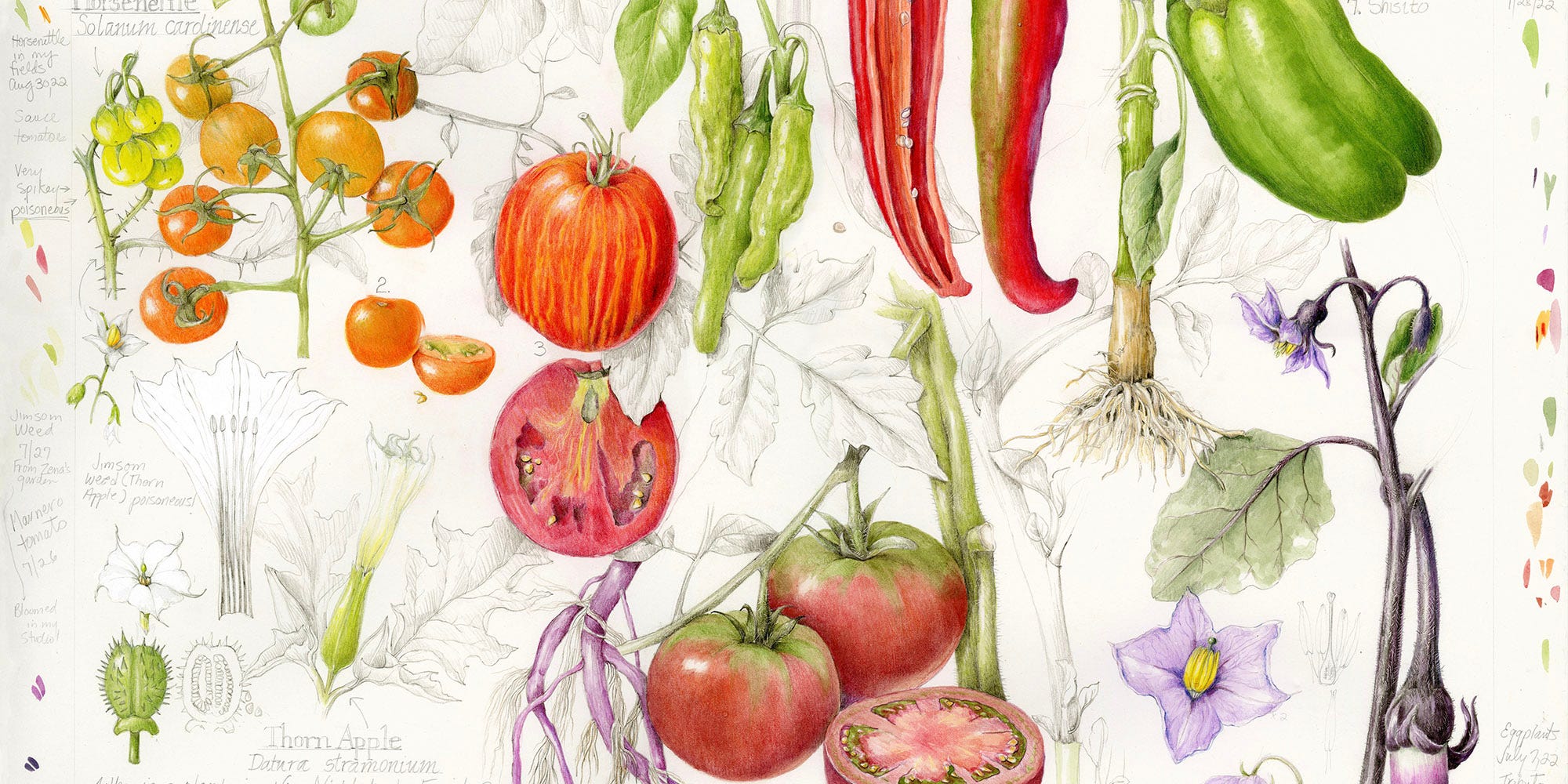
Today’s more than 10,000 tomato varieties can be traced back to the single Solanum lycopersicum, which was first found growing wild in the Andes roughly 80,000 years ago. The tomato’s millenia-long journey up the coast – through modern-day Ecuador, northern Chile, and the Galápagos – remains a mystery. The fruit’s first recorded name, however, is known to us: xitomatl, given by the Nahua people, among its most enthusiastic early cultivators.
In 1521, after the Spanish invasion destroyed the Aztec capital of Tenochtitlan, the tomato was pulled into the crosscurrents of colonial conquest/subjugation, eventually landing in the Caribbean and Europe. To the people of Europe, its arrival sparked curiosity, then concern: only the wealthy could afford this transplanted delicacy, and had the awkward side effect of making them ill. For over a century, the tomato fell into its new continental category of “poison” until an explanation emerged: the wealthy’s delicate dishware — pewter plates rich in lead — were secreting the toxic metal in the presence of the tomato’s vibrant acidity. Another theory, perhaps less engrossing, traced the tomatoes’ resemblance to the poisonous belladonna plant.
Today, the tomato is everywhere – central to countless cuisines, chopped, sauced, and sung over. It has voyaged across physical and psychological landscapes, been shaped and relocated by oppressive forces, and subjected to scientific and societal imagination and (re)interpretation. And yet, as with many trajectories measured by particular strains of modernity, the tomato remains framed in terms of its human uses. What might the tomato say of its passage through time and space, if we were to change what guides our gaze?
Stuff for Study: Tastemaking
Readings and other resources for continued learning on attention and politics
A brief history of spectacular dining — Fanny Singer for Frieze
Seeing the city by way of the grocery aisles — Richard Morgan for New York Magazine
The life and death of the American foodie — Jaya Saxena for Eater
Why are we seeing viral recipes on our commute? — Willa Glickman for Hell Gate
Corn tastes better on the honor system — Robin Wall Kimmerer for Emergence Magazine
Food past, food futures: the culinary history of COVID-19 — The Global Historiography Collective for Public Domain Review
— Czarina Ramos
IRL

Thu, March 12th: Join us for our IRL seminar COMPLEXITY, where we’ll explore how complex systems—neither chaotic nor ordered—shape our attention and reveal new ways to navigate an ever-shifting world. Enroll HERE.
Sat, March 14th in Austin, TX: Join D. Graham Burnett and Alyssa Loh of the Friends of Attention for an evening celebrating our new book, ATTENSITY! A Manifesto of the Attention Liberation Movement at SXSW. In this intimate event, Graham and Alyssa will read from Attensity!, discuss the practice of attention activism, and take questions from the audience. RSVP HERE.
Mon, March 16th: ATTENTION LAB: SANCTUARY is an experiential, participatory workshop dedicated to the joint exploration of radical human attention with a focus on sanctuary’’s role in Attention Activism. Sign up HERE.
Find more workshops, events, and gatherings here!