
Leveled Up
On attention to video games

Friends!
Clayton, Missouri, 2003: I’m in the basement of my parent’s house watching the older kids (brother, sister, cousins) play Mario Kart 64 on our staticky, five-thousand-pound television. I’ve never been a gamer, and prefer to spectate in these scenarios, but when my cousin Devon hands me her three-pronged controller, I solemnly accept. “Hold A when the light goes blue,” she advises me. “You’ll get a boost right at the start.”
I take my seat at the edge of the beanbag and fix my gaze on the upper right quadrant of the split-screen. Our racecourse is Rainbow Road. When the traffic light timer counts down, I jam “A” with all the might in my thumb and accelerate along a versicolor ribbon into the star-speckled void of space.
After the first lap, I’m in the lead and starting to feel pretty good about myself. My turns are perfectly timed; I’m skidding on the edge of a dime; my green shells fly with sniper precision. I am cruising. I am crushing these losers.
When I cross the finish line first, I can hardly contain my pride. Only once my sister Liza and cousin Patrick clock in for silver and bronze does someone point out, laughing, that Player 3 (Toad) is stalled, nose against the shimmering rainbow border wall, having travelled no more than five car lengths from the starting line. The heat blooms in my cheeks as I understand: Player 3 is me! I had been looking at my brother’s screen the whole time, thinking I was creaming everybody else while, instead, driving repeatedly over the edge of the road, only to be hoisted up by a cloud-surfing turtle and set back right where I started.
I learned a valuable lesson that day: The gap between a player’s physical inputs and the digital performance onscreen – a gap that literally defines the video game as a technology – can only be bridged by close attention. My simple mistake of looking at the wrong quadrant ruined the delicate cybernetic dance that is Mario Kart 64. This insight marked the inglorious end of my gaming career.
This week, we’re thinking about VIDEO GAMES and the special forms of attention that bridge our digital and physical worlds. In Visions of Attention, Haena looks at Lynn Leeson’s Lorna (1984) to think about different ways of “playing” characters. In Stuff for Study, Czarina shares writing on video games from Hanif Abdurraqib and Tony Tulathimutte. And in IRL, we share upcoming programs at SoRA, including our seminar on ANIMAL PHENOMENOLOGY. And if you missed our recent exhibition on gamemaking, Beyond Dark Flow, check out this write-up from Whitehot Magazine.
In splitscreen solidarity,
Peter Schmidt
Editor-in-Chief
Visions of Attention
An archive of images and mini-essays on the myriad modes of attention
Lorna, Our Star
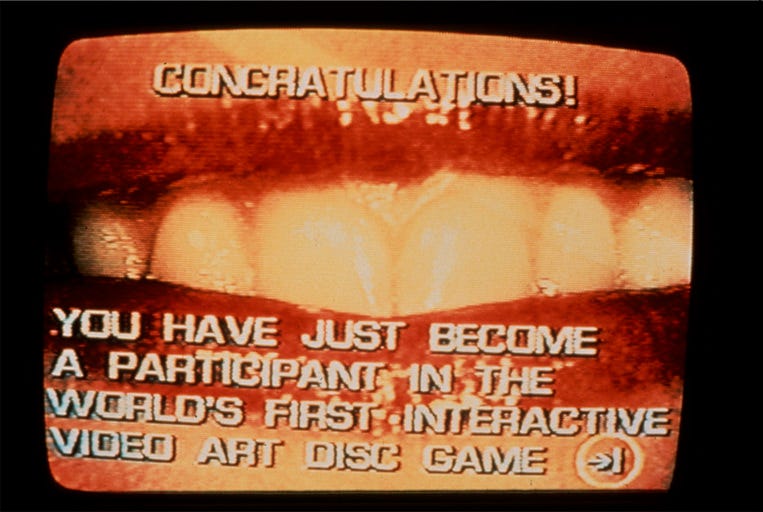
Age: 40
Fears: Everything
Has not left her home in 4 ½ years
So begins Lynn Hershman Leeson’s Lorna (1979–84), an interactive video on LaserDisc played on a television set. With this prescient work, Leeson adopted a then-new commercial technology and repurposed its recording and menu functions to create a form of visual storytelling distinct from existing video games built around text commands.
There is a subtle but important difference between, say, a player playing “as” Mario or Luigi, and a player controlling our agoraphobic protagonist Lorna as she interacts with a small set of objects in her room. From the beginning, she is introduced as “our star” in the manner of a TV show. Throughout the game, the outside world threatens to breach Lorna’s private space via the television and phone. Players know the threat of invasion isn’t just a threat — it’s already happening, thanks to their own morally uncomfortable role of the silent voyeur.
Indeed, Hershman characterizes Lorna as an “artificially intelligent creature” — not a substitute for the player, but a being whose independent existence only confirms her total subjugation to the rules of the game and its designer. Lorna is not an instrument. She is an artificial woman-made-instrument.
As Hershman stated in her 1994 essay, “truth is precisely based on the inauthentic.” The inauthentic exposes the designed choices in video games and in other life-like fictions.
— Haena Chu
Stuff for Study: Reading Player One
Readings and other resources for continued learning on attention and politics
We’re more ghosts than people: on heaven within Red Dead Redemption — Hanif Abdurraqib for The Paris Review
Sid Meier and the meaning of Civilization — Neima Jahromi for The New Yorker
The allure of the video games apocalypse — Will Wiles for Aeon
Clash rules everything around me: on wasted time — Tony Tulathimutte for Real Life
Asking Claude to re-build Star Trek — Paul Taylor for The London Review of Books
The art of the longplay — Alex Wennerberg for The Empty Cup
— Czarina Ramos
IRL

Thu, July 2nd: ATTENTION LAB: STUDY is a participatory workshop dedicated to the joint exploration of radical human attention. Sign up HERE!
Mon, July 6th: Join us for our IRL seminar ANIMAL PHENOMENOLOGY, where we will attend to creatures and present ways of understanding non-human life-worlds. Enroll HERE!
Find more workshops, events, and gatherings HERE!