

Cameron Cassar is a facilitator at the School of Radical Attention, as well as an educator and organizer working at the nexus of prison reform and movement building. He currently teaches organizations and practitioners how to develop restorative justice and violence intervention programs. He sat down with our managing editor, Czarina Ramos, to discuss the role of grief and mourning as acts of collective attention in social movements.

CR: It’s great to see you, Cam. Last summer, you taught a course at SoRA called “Martyrs and Movements.” Can you tell our readers about what inspired this course?
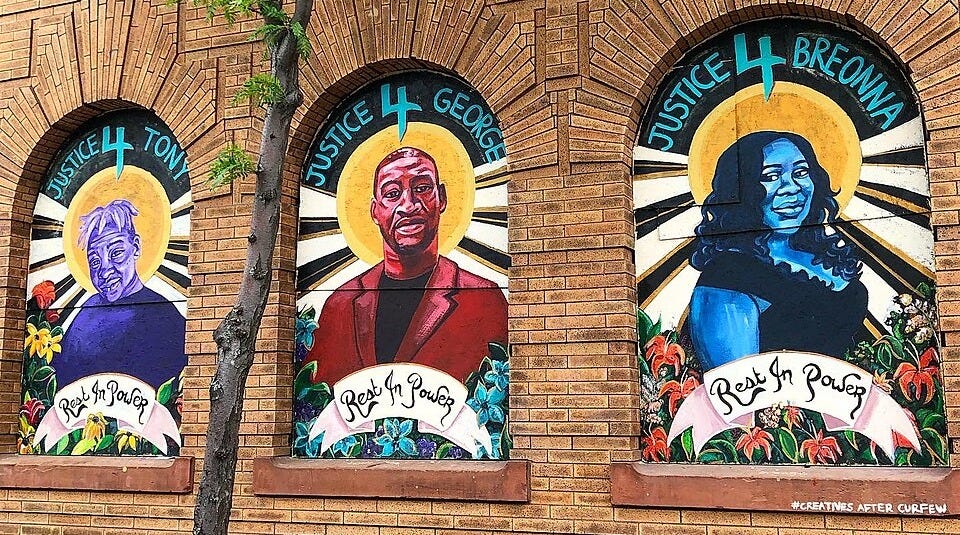
CC: It was inspired by my master’s thesis, which was titled Of Martyrs and Men. I became very interested in the role of trauma in social movements during the “post-Covid” period. I was inspired by how the George Floyd protests took intergenerational trauma, relative deprivation, and just a lot of unresolved rage and converted it into political energy. I also had an interest in the Arab Spring from a young age, since it was my first life experience seeing revolution in real time. I realized, as I started to conduct some of my early research, that there were parallels between these two cases and their origins. I was thinking a lot about what mobilizes people to seize power. How can the act of police brutality mobilize people? Why did these spectacles of violence motivate people to go out and team up against these big institutions?
In the class, we talked about martyrs as symbols. Many of us think about martyrdom in religious terms. But secular martyrdom is largely symbolic, and the symbol of a martyr can be a focal point of collective attention with special political powers.
CR: I’m curious about the conditions that led to these particular moments of collective attention. In the case of the George Floyd protests, a lot of us were very online during lockdown.
CC: The role of social media was critical in both of those movements. In the George Floyd protests, we saw that video. It came out immediately and it was omnipresent — you could not escape the footage anywhere. Whereas when Khaled Saeed died, the Egyptian authorities initially tried to withhold access to all imagery. They only released the images later because people were organizing on Facebook to demand the release of the images. We saw how people could utilize social media to collectivize righteous rage and build political power.
In Egypt, the fact that people used Facebook to organize and go up against the institutions showed observers at the time that social media could be a core tenet of movement building. On the other hand, we saw the Cambridge Analytica story unfold. So we’ve both seen, on the one hand, how social media can be a system for political legitimation and solidarity, but also, on the other, as a way for bad institutional actors to control narratives and political outcomes. And they do so not just by commodifying but also by weaponizing attention through misinformation and disinformation — not to mention information overload.
“Many marginalized communities are in a constant state of grief. We have to ask, how do we politicize our grief? This is how we begin to mobilize resistance, even in the face of despair.”
CR: We see a tension here, with social media democratizing information while also serving efforts of attentional control. Why do you think these particular symbols and stories set off such massive responses from the public? There are, unfortunately, many news stories about police brutality that garner comparatively little attention.
CC: I think that’s where the ripeness of the conflict plays a big part. People were already fed up with what they saw as the legitimacy of the justice system collapsing before their eyes, and the footage affirmed violence and brutality of their conditions.
Now, collapse of legitimacy is a part of it, but it’s not the only factor. We live in a world where many of us see violence so often that we’re desensitized to it. For certain populations that take part in movements, unresolved mourning also plays a huge part in igniting action. Mohammed Bouazizi’s self-immolation in Tunisia was preceded by the death of Khaled Saeed. After seeing Mohammed Bouazizi light himself on fire as a sign of resistance, Tunisians mobilized to topple President Ben Ali. Bouazizi’s tragic self-immolation planted a seed throughout the region, including Egypt, where people soon after led their own revolution to topple then-President Hosni Mubarak. People felt: We can actually fight back. It has to be now.
When you look at George Floyd, COVID played a big part as well, but there were also two other cases of violence: Ahmaud Arbery, who was the young black man lynched while jogging, and Breonna Taylor, who was shot in her home just as COVID lockdowns were beginning. By the time George Floyd’s murder happened, he was the straw that broke the camel’s back.
So one factor was the buildup of those other injustices. This is why we have to attend to unresolved mourning, both in our analysis and in our strategy.
CR: In A Paradise Built in Hell, Rebecca Solnit talks about how, in moments of disaster, everyday conditions are suspended and we’re able to care for each other in extraordinary ways. Do we need disasters to attend to unresolved mourning and collective grief?
CC: Disasters aren’t needed, but the suspension of everyday conditions allows space for people to attend to emotions that might otherwise be suppressed. Emotions are deeply political — at least, they can be politicized. So leaning into our love and rage and grief can give emotion and action a way to move in the world. Many marginalized communities are in a constant state of grief. We have to ask, how do we politicize our grief? This is how we begin to mobilize resistance, even in the face of despair.
CR: You modelled one strategy when you had us attend to the memory of a martyr. That seems important when we’re thinking about attention as a practice of collective resistance.
CC: For sure. When we attend to the memory of our martyr, we live with that grief and we get enraged by their death — but is rage not rooted in love? The love for the fallen is the material that we use to build this world. We say: the power that they took from you when they took your life is power I’m redirecting to build a new world. It’s all about love; love is the ultimate guiding factor.